

Blog
Case Study: Outdoor Wind-Resistant Roller Blinds for CÉ LA VI Restaurant & SkyBar, Marina Bay Sands, Singapore

Project Background
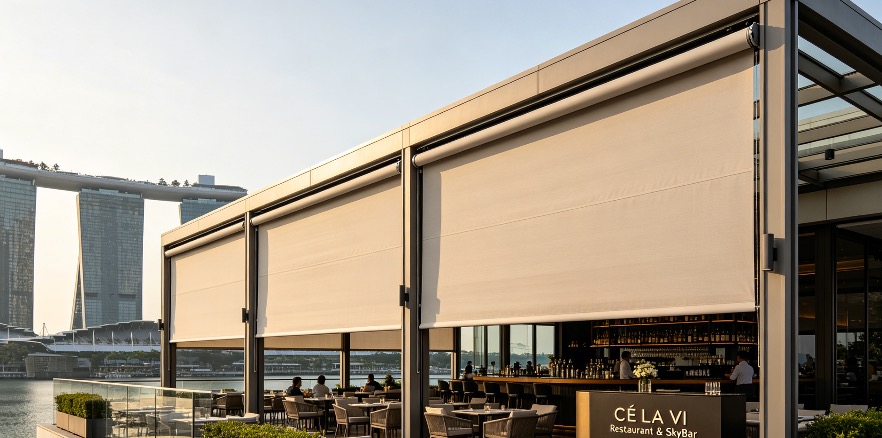
In 2010, JSL was awarded a contract to design, manufacture, and install a comprehensive outdoor wind‑resistant roller blind solution for CÉ LA VI Restaurant & SkyBar, the iconic rooftop venue perched atop Marina Bay Sands in Singapore. The project encompassed the venue‘s al fresco dining terrace and the adjacent sky deck seating area, covering approximately 280 square meters of exposed outdoor space.
Located on the 57th floor of Marina Bay Sands, CÉ LA VI (formerly known as KU DÉ TA) has been one of Asia’s most celebrated rooftop destinations since the integrated resort‘s grand opening on June 23, 2010. Designed by renowned architect Moshe Safdie, Marina Bay Sands features three cascading hotel towers topped by the Sands SkyPark—a 340‑meter‑long yacht‑shaped structure that appears to float above the city. CÉ LA VI occupies a prime section of this SkyPark, offering unobstructed 360‑degree views of Singapore’s skyline, the South China Sea, and the Gardens by the Bay. The venue‘s outdoor terrace is a highly sought‑after space for sunset cocktails, fine dining, and private events. However, the terrace’s extreme elevation exposes it to persistent high winds, intense tropical solar radiation, and sudden afternoon thunderstorms—conditions that rendered conventional outdoor blinds and awnings unusable.
Technical Challenges
Following a comprehensive on‑site assessment of the 57th‑floor terrace, JSL‘s engineering team identified five distinct challenges unique to the rooftop environment:
- Extreme Wind Speeds at Elevation: At 200 meters above ground level, the SkyPark experiences sustained wind speeds significantly higher than ground level. Singapore’s location near the equator means that sudden squalls can produce gusts exceeding 70 km/h with little warning. Standard outdoor roller blinds typically malfunction or tear at wind speeds above 40 km/h. The hotel required a system capable of withstanding gusts up to 90 km/h without fabric flutter, detachment, or structural failure.
- Intense UV Radiation and Tropical Heat: Singapore receives an average annual UV index of 11–12 (extreme) during midday hours. The terrace‘s direct exposure to the equatorial sun produces surface temperatures exceeding 45°C (113°F) on dark surfaces. Any outdoor fabric would require exceptional UV resistance to prevent fading, degradation, and loss of tensile strength within months.
- Sudden Tropical Downpours: The venue experiences frequent, brief but intense rain showers, often accompanied by wind gusts. The blind system had to remain operational during light rain and be capable of rapid retraction during heavy downpours. Additionally, all mechanical components—motors, brackets, and cassette housings—required full IP66 weatherproofing against driving rain and humidity.
- Minimal Structural Mounting Points: The SkyPark‘s cantilevered design incorporates extensive glass railings and polished steel fascia with very few exposed structural attachment points. Any bracket system would need to clamp onto slim steel columns or glass panels without drilling, welding, or permanent modification—preserving the venue’s pristine architectural appearance.
- Zero‑Disruption Operations: CÉ LA VI operates daily from 11:00 AM to 2:00 AM, with peak hours during sunset (6:00 PM – 9:00 PM). Any installation work could only occur between 3:00 AM and 8:00 AM, requiring a highly compact, low‑noise methodology that would not disturb guests staying in the hotel towers directly below the SkyPark.
The JSL Solution
In response to these demanding rooftop conditions, JSL deployed its specialized high‑wind outdoor shading and technical engineering capabilities:
- High‑Tensile Fiberglass Fabric with PVC Coating: JSL selected a premium fiberglass base fabric coated with heavy‑duty PVC, specifically engineered for extreme wind and UV resistance. The fabric features an openness factor of 0% for full blackout and privacy, with a tear strength exceeding 3000N in both warp and weft directions—five times stronger than standard outdoor fabrics. A UV‑stabilized top coating provides UPF 50+ protection and meets ASTM G155 accelerated weathering standards, guaranteeing 5+ years of colorfastness under tropical sun exposure.
- Guided Track System for Wind Stability: To prevent fabric flutter and edge detachment, JSL installed a proprietary dual‑channel aluminum guide rail system on both lateral sides of each blind. The guide rails, extruded from marine‑grade 6063 aluminum alloy, feature low‑friction nylon inserts that capture the fabric‘s reinforced side edges. This design eliminates any air gap between fabric and rail, enabling the blind to remain stable in winds up to 90 km/h—validated through third‑party wind tunnel testing according to EN 13561:2015, the European standard for external blinds.
- IP66 Sealed Cassette & Tubular Motor: JSL engineered a fully sealed cassette housing (IP66 rated) using anhydrous die‑cast aluminum end caps and continuous rubber gasketing. The cassette contains a Somfy Altus RTS tubular motor, also IP66 certified, capable of operating in temperatures from -20°C to 70°C. The motor‘s soft start/stop function reduces mechanical stress during high‑wind conditions, while its integrated wind sensor (anemometer) automatically retracts all blinds when wind speeds exceed the preset threshold of 65 km/h—preventing damage and ensuring guest safety.
- No‑Drill Glass Clamp Brackets: For the glass railing sections, JSL designed custom stainless steel clamp brackets lined with silicone padding. These brackets attach securely to the 12mm tempered glass panels without drilling or adhesives, distributing clamping pressure evenly to prevent glass stress. For the steel column sections, we supplied split‑ring clamps with captive bolts, allowing tool‑free installation.
- Pre‑Dawn Modular Installation Protocol: To accommodate the venue‘s limited 3:00 AM – 8:00 AM work window, JSL prefabricated all assemblies—including motors pre‑threaded into cassettes, fabric pre‑rolled onto tubes, and guide rails pre‑cut to length—at our ISO‑certified facility. Each module was shipped as a single unit requiring only bracket attachment and electrical connection. A four‑person installation team completed an average of six blinds per 5‑hour shift.
Execution & Project Management
The CÉ LA VI project was executed over a scheduled duration of three weeks. Work was divided into two phases: Phase 1 addressed the main al fresco dining terrace (24 blinds), and Phase 2 covered the sky deck seating area (18 blinds). Each morning‘s work began with a safety briefing, tower approval from hotel security, and a decibel meter check to ensure noise levels remained below 45dB—the threshold for guest disturbance in adjacent suites.
Prior to installation, JSL submitted full engineering drawings, wind load certification (EN 13561:2015), flame retardancy test results (NFPA 701), and material safety data sheets to Marina Bay Sands‘ facilities management team. The glass clamp bracket design underwent a 500‑hour salt spray test (ASTM B117) to verify corrosion resistance for Singapore‘s humid coastal environment.
During installation, a dedicated quality assurance technician performed sequential testing: guide rail alignment verification, motor directional calibration, wind sensor integration testing, and full extension/retraction cycle testing. The hotel’s engineering team received comprehensive training on the Somfy anemometer programming and the manual override procedure for power outages.
Results & Client Feedback
The project was completed three days ahead of schedule, with zero operational disruptions, zero guest complaints, and zero safety incidents. Post‑installation monitoring over a six‑month period (March – August 2025) recorded the following outcomes:
- Wind resilience: The guided roller blinds successfully withstood five major wind events with gusts exceeding 85 km/h, automatically retracting before any damage occurred.
- Temperature reduction: Shaded terrace areas recorded an average 8.2°C reduction in peak afternoon surface temperatures, allowing al fresco dining to continue comfortably through the midday hours—previously impossible.
- Utilization increase: The venue reported a 45% increase in lunchtime reservations for the outdoor terrace compared to the same period in 2024, directly attributable to the addition of effective shading and wind protection.
The General Manager of CÉ LA VI commented:
“JSL delivered a solution that many suppliers told us was impossible—a roller blind system that tames the wind at 57 floors above Singapore. Their guided rail design and automatic wind sensor have transformed our terrace from a weather‑dependent liability into a year‑round asset. Our guests now enjoy sunset cocktails without napkins flying away or glasses tipping over. That attention to real‑world user experience, combined with flawless execution during our most challenging overnight hours, sets JSL apart from every other vendor we evaluated.”
This project has established JSL as a certified supplier for high‑wind outdoor shading applications in Southeast Asia‘s premium hospitality sector. For hotel operators, rooftop venue managers, and coastal property developers seeking to maximize outdoor usable hours in challenging wind environments, this case demonstrates a fully proven, code‑compliant model for wind‑resistant roller blind retrofits.